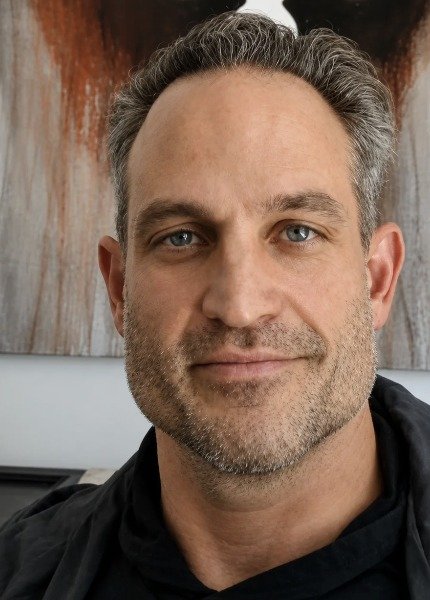
I'm Zeev Kirsh — attorney, investor, and founder of Zeev.org. I track the companies, technologies, and market structure behind the rise of physical AI: humanoids, drones, industrial automation, and the suppliers building the next decade of the real-world economy.
AI was the software story. Robotics is the physical economy story.
Industrial robot installations hit 542,000 units in 2024 — more than double the level from ten years earlier. Goldman Sachs projects humanoid robots could reach a $38 billion market by 2035. Morgan Stanley models a path to $5 trillion by 2050. The robotics decade is not a prediction. It is already underway.
Physical AI is the convergence of advanced AI models with robotic bodies capable of operating in the real world. Unlike software AI, physical AI must perceive, plan, and act in environments designed for humans — which makes it simultaneously harder to build and vastly more valuable when it works. The enabling infrastructure includes not just the robots themselves, but the actuators, sensors, batteries, chips, simulation tools, and deployment platforms that make scale possible. The most investable opportunities may not be the headline humanoid companies — they may be the boring suppliers who win regardless of which robot body prevails.
A living market map of every robotics category: humanoids, drones, industrial automation, medical robots, farm robots, construction robots, and the enabling supply chain.
Every robotics company gets classified: Demo, Pilot, Deployment, Revenue, or Scaled Revenue. Most viral robot videos are demos. The money starts when a robot solves a real job.
Weekly breakdowns of what changed, who raised, who shipped, who matters — and what is investable. The Physical AI Stack from brain to body to energy to deployment.
From public equities to private rounds to SPV opportunities — structured for accredited investors who want to understand the robotics map before it becomes consensus.
Robotics is full of beautiful demos. Every company Zeev.org tracks gets classified against this ladder.
Controlled environment. Impressive — not investable on its own.
Real customer, real environment. Meaningful signal, not yet proof.
A robot doing a real job, repeatedly. This is where the thesis begins to validate.
Renewals, expansion, defensible unit economics. The difference between a startup and a business.
Zeev.org is built for accredited investors seeking private robotics opportunities and SPV deal flow; family offices building thematic exposure to physical AI; founders and operators in the robotics supply chain; technology and finance professionals tracking physical AI convergence; and anyone who watched a humanoid robot video and wanted to know whether it was a demo, a pilot, or a business.
I'm an attorney and investor building Zeev.org — a robotics intelligence platform for investors who want to understand the physical AI era before it becomes consensus. My focus is on the companies, founders, and market structure behind humanoids, drones, industrial automation, and the enabling supply chain.
My legal background spans corporate bankruptcy during the financial crisis (Lehman, Bear Stearns, AIG), securities and derivatives litigation, IP licensing, and crypto-market compliance work dating back to the Senate hearings of 2013. I bring institutional capital-markets experience to the robotics investment thesis.
I am a student of sociology and natural philosophy, influenced by Karl Popper, James Randi, Francis Bacon, the Royal Society of London, the Tavistock Society, and Auguste Comte. I believe rigorous thinking and direct observation are the only tools that separate real robotics deployments from beautiful demos.
My framework for every robotics company is one question: what painful real-world job does this robot do, who pays for it, and why does it work now? That question cuts through the hype faster than any benchmark.
I attended Columbia Law School and Stuyvesant High School, studied Maths, Biology, and Religion, and advise seed and early-stage technology companies on investment documentation. I am an avid fan of architecture, the future of simulating the full stack demolition and construction of existing neighborhoods and total cities. The Network State and Special Economic Zone concepts have laid the groundwork for digital permissioning and legal permissioning in a rapidly resystemizing world. However, the missing link is the 100x productivity leap enabled by robotic construction and system maintenance development. We are within thirty years of potentially building a new method for creating multiplexed cities with incomparably better quality of life for hundreds of millions of people — cities whose existence are presently unfathomable, but without question, can be made possible by the future of robotics. While there is some ideological optimism in this viewpoint, Zeev.org maintains a practical, growth-focused outlook for the reasonable timeframe of 2 to 10 years out from the present state of art investable frontier robotics development. That said, this is about far more than margins and profit — this is about the future of our species.
The convergence of robotics with urban infrastructure represents perhaps the most consequential long-horizon thesis in technology. Autonomous construction systems, robotic maintenance fleets, and AI-coordinated city management are not science fiction — they are engineering problems with known solution paths. Within a generation, we may possess the tools to design, build, and operate cities of unprecedented quality and density, in locations presently considered uninhabitable, at costs that make such projects economically viable. The question is not whether robotic cities will exist — it is who will build them, where, and under what legal and governance frameworks.
Principle City is not an investor thesis provided by zeev.org, but a related, and longer duration existential thesis on robotics — for those interested, click here.
Principle City ↗Whether you want to discuss robotics investment opportunities, partner, or join the intelligence community — reach out.